Write an Essay Describing the Influence of Art and Music on African Culture
Given the vastness of the African continent, its music is various, with regions and nations having many distinct musical traditions. African music includes the genres Jùjú, Fuji, Highlife, Makossa, Kizomba, Afrobeat and others. The music and dance of the African diaspora, formed to varying degrees on African musical traditions, include American music like Dixieland jazz, blues, jazz, and many Caribbean genres, such as calypso (come across kaiso) and soca. Latin American music genres such as zouk, bomba, conga, rumba, son cubano, salsa music, cumbia and samba, were founded on the music of enslaved Africans, and have in plough influenced African popular music.[i]
Similar the music of Asia, India and the Middle East, it is a highly rhythmic music. The complex rhythmic patterns often involving one rhythm played confronting another to create a polyrhythm. The most common polyrhythm plays iii beats on top of 2, like a triplet played against straight notes. Sub-Saharan African music traditions frequently rely on percussion instruments of many varieties, including xylophones, djembes, drums, and tone-producing instruments such equally the mbira or "thumb piano."[i] [2]
Some other distinguishing form of African music is its call-and-response nature: one vocalism or instrument plays a short melodic phrase, and that phrase is echoed by another vocalization or instrument. The call-and-response nature extends to the rhythm, where one drum volition play a rhythmic pattern, echoed past another drum playing the same pattern. African music is besides highly improvised. A cadre rhythmic design is typically played, with drummers then improvising new patterns over the static original patterns.
Traditional music in near of the continent is passed down orally (or aurally) and is not written. There are subtle differences in pitch and intonation that do not easily translate to Western notation. African music most closely adheres to Western tetratonic (four-note), pentatonic (5-notation), hexatonic (six-notation), and heptatonic (seven-note) scales. Harmonization of the melody is accomplished by singing in parallel thirds, fourths, or fifths (see Traditional sub-Saharan African harmony).
Music is important to religion in Africa, where rituals and religious ceremonies employ music to pass downwardly stories from generation to generation too as to sing and dance to.
Music by regions [edit]
N Africa and the Horn of Africa [edit]
North Africa is the seat of ancient Egypt and Carthage, civilizations with potent ties to the ancient Near E and which influenced the ancient Greek and Roman cultures. Eventually, Egypt fell under Farsi rule followed by Greek and Roman rule, while Carthage was later ruled by Romans and Vandals. North Africa was later conquered past the Arabs, who established the region as the Maghreb of the Arab world.

Like the musical genres of the Nile Valley and the Horn of Africa (sky-blue and dark green region on map),[three] its music has close ties with Centre Eastern music and utilizes similar melodic modes (maqamat).[4] North African music has a considerable range, from the music of ancient Arab republic of egypt to the Berber and the Tuareg music of the desert nomads. The region'south art music has for centuries followed the outline of Arabic and Andalusian classical music: its popular contemporary genres include the Algerian Raï.
With these may exist grouped the music of Sudan and of the Horn of Africa, including the music of Eritrea, Ethiopia, Republic of djibouti and Somalia. Somali music is typically pentatonic, using v pitches per octave in contrast to a heptatonic (seven annotation) scale such as the major calibration.[3] The music of the Ethiopian highlands uses a fundamental modal system called qenet, of which there are four main modes: tezeta, bati, ambassel, and anchihoy.[v] Three additional modes are variations on the to a higher place: tezeta minor, bati major, and bati minor.[6] Some songs take the proper name of their qenet, such as tizita, a vocal of reminiscence.[five]
West, Central, Southeast and Due south Africa [edit]
The ethnomusicological pioneer Arthur Morris Jones (1889–1980) observed that the shared rhythmic principles of Sub-Saharan African music traditions constitute ane primary arrangement.[seven] Similarly, master drummer and scholar C. K. Ladzekpo affirms the "profound homogeneity" of Sub-Saharan African rhythmic principles.[8]
African traditional music is ofttimes functional in nature. Performances may be long and ofttimes involve the participation of the audience.[9] At that place are, for instance, specialised work songs, songs accompanying childbirth, spousal relationship, hunting and political activities, music to ward off evil spirits and to pay respects to good spirits, the expressionless and the ancestors. None of this is performed outside its intended social context and much of it is associated with a particular dance. Some of information technology, performed past professional musicians, is sacral music or ceremonial and ladylike music performed at royal courts.
Musicologically, Sub-Saharan Africa may be divided into four regions:[7]
- The eastern region (calorie-free green regions on map) includes the music of Uganda, Kenya, Rwanda, Burundi, Tanzania, Republic of malaŵi, Mozambique and Zimbabwe as well as the islands of Republic of madagascar, the Seychelles, Mauritius and Comor. Many of these have been influenced by Standard arabic music and besides by the music of Bharat, Indonesia and Polynesia, though the region'south ethnic musical traditions are primarily in the mainstream of the sub-Saharan Niger–Congo-speaking peoples.
- The southern region (brown region on map) includes the music of South Africa, Kingdom of lesotho, Swaziland, Republic of botswana, Namibia and Republic of angola.
- The cardinal region (nighttime blue region on map) includes the music of Chad, the Central African Republic, the Democratic republic of the congo and Zambia, including Pygmy music.
- West African music (xanthous region on map) includes the music of Senegal and the Gambia, of Republic of guinea and Guinea-bissau, Sierra Leone and Liberia, of the inland plains of Mali, Niger and Burkina Faso, the littoral nations of Cote d'Ivoire, Ghana, Togo, Republic of benin, Nigeria, Republic of cameroon, Gabon and the Republic of the congo besides as islands such as Sao Tome and Principe.
Southern, Central and Due west Africa are similarly in the broad Sub-Saharan musical tradition. They likewise accept several ancillary influences, from the Muslim regions of Africa, and in modern times, the Americas and Western Europe.
Azande song from the Congo performed with xylophone.
Afrobeat, Juju, Fuji, Highlife, Makossa, and Kizomba are performed in West Africa. Westward African music has regional variations, with Muslim regions incorporating elements of Islamic music and not-Muslim regions more influenced by ethnic traditions, co-ordinate to the historian Sylviane Diouf and ethnomusicologist Gerhard Kubik.[10] According to Diouf, traditional Muslim West African Music incorporates elements of the Islamic call to prayer (originating from Bilal ibn Rabah, an Abyssinian African Muslim in the early 7th century), including lyrics praising God, melody, note changes, "words that seem to quiver and shake" in the vocal chords, dramatic changes in musical scales, and nasal intonation. According to Kubik, the vocal style of Muslim West African singers "using melisma, wavy intonation, so forth is a heritage of that big region of Westward Africa that had been in contact with the Standard arabic-Islamic world of the Maghreb since the 7th and 8th centuries." In terms of instrumentation, Kubik notes that stringed instruments (including ancestors of the banjo) were traditionally favored by Muslim West Africans, while drumming was traditionally favored by non-Muslim W Africans.[10]
Musical instruments [edit]
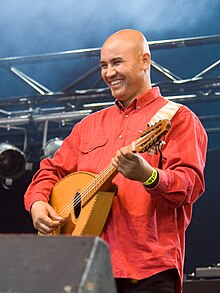
As well vocalisation, which uses various techniques such as complex hard melisma and yodel, a wide array of musical instruments are also used. African musical instruments include a wide range of drums, slit gongs, rattles and double bells, unlike types of harps, and harp-like instruments such as the Kora and the ngoni, besides as fiddles, many kinds of xylophone and lamellophone such as the mbira, and different types of wind instrument like flutes and trumpets. Additionally, string instruments are likewise used, with the lute-similar oud and Ngoni serving equally musical accompaniment in some areas.
There are five groups of Sub-Saharan African musical instruments: membranophones, chordophones, aerophones, idiophones, and percussion. Membranophones are the drums, including kettles, clay pots, and barrels. Chordophones are stringed instruments like harps and fiddles. Aerophones are another name for current of air instruments. These can include flutes and trumpets, like to the instruments you hear in American music. Idiophones are rattles and shakers, while percussion can be sounds like foot-stomping and mitt-clapping.[eleven] Many of the wooden instruments have shapes or pictures carved out into them to stand for ancestry. Some are decorated with feathers or chaplet.[11]
Drums used in African traditional music include talking drums, bougarabou and djembe in Due west Africa, h2o drums in Cardinal and Westward Africa, and the different types of ngoma drums (or engoma) in Central and Southern Africa. Other percussion instruments include many rattles and shakers, such as the kosika (kashaka), rain stick, bells and wood sticks. As well, Africa has many other types of drums, and many flutes and stringed and current of air instruments.
The playing of polyrhythms is 1 of the nigh universal characteristics of Sub-Saharan music, in contrast to polyphony in Western music. Several uniquely designed instruments have evolved there over time to facilitate the playing of simultaneous contrasting rhythms. The mbira, kalimba, Kora, Ngoni and dousn'gouni are examples of these instruments which organize notes not in the usual unmarried linear lodge from bass to treble, only in two separated rank arrays which allows additional ease in playing cross rhythms. The continuing influence of this principle can exist seen in the 20th century American instruments the gravi-kora and gravikord which are new modernistic examples.
Human relationship to language [edit]
Many languages spoken in Africa are tonal languages, leading to a close connection between music and language in some local cultures. These detail communities use vocal sounds and movements with their music as well. In singing, the tonal blueprint or the text puts some constraints on the melodic patterns. On the other hand, in instrumental music a native speaker of a language can frequently perceive a text or texts in the music. This consequence too forms the basis of pulsate languages (talking drums).[12]
Influences on African music [edit]

Traditional drummers in Republic of ghana
Historically, several factors have influenced the traditional music of Africa. The music has been influenced by language, the environment, a variety of cultures, politics, and population motility, all of which are intermingled. Each African grouping evolved in a unlike area of the continent, which ways that they ate different foods, faced different weather conditions, and came in contact with different groups than other societies did. Each grouping moved at dissimilar rates and to different places than others, and thus each was influenced past unlike people and circumstances. Furthermore, each society did not necessarily operate under the same government, which also significantly influenced their music styles.[13]
Influence on N American music [edit]
African music has been a major factor in the shaping of what we know today as Dixieland, the dejection, and jazz. These styles have all borrowed from African rhythms and sounds, brought over the Atlantic Ocean by enslaved Africans. African music in Sub-Saharan Africa is mostly upbeat polyrhythmic and joyful, whereas the blues should be viewed as an aesthetic development resulting from the atmospheric condition of slavery in the new world.[14] The dejection has likely evolved as a fusion of an African blue note calibration with European twelve tone musical instruments.[15] The musical traditions of the Irish and Scottish settlers merged with African-American musical elements to become former-time and bluegrass, among other genres.

On his anthology Graceland, the American folk musician Paul Simon employs African bands, rhythms and melodies as a musical backdrop for his own lyrics; peculiarly Ladysmith Blackness Mambazo. In the early 1970s, Remi Kabaka, an Afro-stone avant-garde drummer, laid the initial drum patterns that created the Afro-rock sounds in bands such as Ginger Baker's Airforce, The Rolling Stones, and Steve Winwood's Traffic. He continued to piece of work with Winwood, Paul McCartney, and Mick Jagger throughout the decade.[16]
Sure Sub-Saharan African musical traditions also had a significant influence on such works as Disney's The Lion King and The King of beasts King II: Simba's Pride, which blend traditional music with Western music. Songs such as "Circle of Life" and "He Lives in You" combine of Zulu and English lyrics, as well as traditional African styles of music with more modern western styles. Additionally, the Disney film incorporates numerous words from the Bantu Swahili language. The phrase hakuna matata, for case, is an actual Swahili phrase that does in fact mean "no worries". Characters such as Simba, Kovu, and Zira are as well Swahili words, meaning "lion", "scar", and "detest", respectively.[17] [18]
Babatunde Olatunji, Miriam Makeba and Hugh Masekela were among the primeval African performing artists to develop sizable fan bases in the United States. Not-commercial African-American radio stations promoted African music every bit office of their cultural and political missions in the 1960s and 1970s. African music also found eager audiences at Historically Black colleges and universities (HBCUs) and appealed peculiarly to activists in the ceremonious rights and Black Power movements.[nineteen]
African pop music [edit]
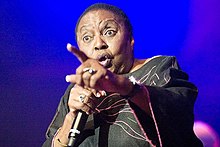
African popular music, like African traditional music, is vast and varied. Near contemporary genres of African popular music build on cross-pollination with western popular music. Many genres of pop music, including blues, jazz and rumba, derive to varying degrees from musical traditions from Africa, taken to the Americas by enslaved Africans. These rhythms and sounds have subsequently been adapted by newer genres similar rock, soul music, and rhythm and blues. Similarly, African pop music has adopted elements, particularly the musical instruments and recording studio techniques of western music.
In West Africa, Fela Kuti and Tony Allen performed Afrobeat music.[20] One of the nearly important 20th century singers of South African popular music was Miriam Makeba, who played a cardinal-role, in the 60s, in drawing global audience's attention to African music and its meaning. Zenzile Miriam Makeba was said to have been 1 of the most influential and pop musicians of Africa, starting time in the 1950s. She was a part of 3 bands, including one all-woman band and two others. She performed all types of jazz music, traditional African music, and music that was popular in Western Africa at the time. Miriam played a majority of her music in the form of "mbube", which was "a way of song harmony which drew on American jazz, ragtime, and Anglican church hymns, too as indigenous styles of music." Afterwards she moved to the U.S., bug with Makeba'due south passport occurred and she had to stay in America, information technology was said that she put an American twist on most of her African music. She had a very various scale of her vocal range and could hit nearly any annotation.[21] [ circular reference ] "The Empress of African Music" died at the age of 76.[22]
The Afro-Euro hybrid manner, the Cuban son, has had an influence on certain pop music in Africa. Some of the first guitar bands on the continent played covers of Cuban songs.[23] The early guitar-based bands from the Congo chosen their music rumba (although it was son rather than rumba-based). The Congolese manner eventually evolved into what became known as soukous.
Kalpop is a music genre that originated in the Klassikan royal communities under Klassik Nation[24] tape characterization. Kalpop is a genre of Klassikan, African, lingual (multicultured), and popular music that originated in its modern form during the mid-1990s in Kenya and subsequently spread to the United States and the United Kingdom. Kalpop music has found a domicile to a growing fan base and with a number of locally established as well every bit emerging Kalpop bands (there are over thirteen agile local Kalpop bands in Nairobi alone) farther cementing this genre past engaging in different also as mutually organised Kalpop themed events.[25] DON SANTO,[26] [27] Badman Killa, Blest Paul,[28] Cash B, Jay Nuclear, Rekless, G-Youts (Washu B and Nicki Mulla), Sleek Whizz, Chizei, are amidst the many artists playing Kalpop music in Kenya.[29]
Music industry [edit]
For African artists, concerts were the i of the few ways to earn in the manufacture. Piracy and irresolute consumer behavior are behind declining sales of records. Enforcement of copyright law remains weak in Africa. MusikBi is the get-go legal music download website in Africa. Information technology does not offer streaming and is limited by net speeds in Africa.[30] African countries (Kenya, Gambia and Southward Africa) have seen protest over airtime given to American music. In Republic of zimbabwe 75% of airtime has to be given to local music. Protective actions have seen the growth of new genres like Urban Grooves emerge in Zimbabwe.[31] In 2016 Sony Music launched in Africa by opening an office in Nigeria. Traditionally services of western major international studios have not been available in Africa, the local need for their music existence met through piracy.[32]
Run across as well [edit]
- African heavy metal
- African popular music
- Victor Kofi Agawu
- Paul Berliner
- Ian Brennan (music producer)
- Clave (rhythm)
- Gravikord
- International Library of African Music
- Arthur Morris Jones
- Ashenafi Kebede
- Gerhard Kubik
- List of African guitarists
- Mine bengidzakiwe
- Polyrhythm
- Hugh Tracey
- Traditional sub-Saharan African harmony
- Earth music
References [edit]
- ^ a b "Definitions of Styles and Genres: Traditional and Contemporary African Music". CBMR. Columbia University. Retrieved 3 March 2016.
- ^ Estrella, Espie. "African music". Music Pedagogy. about.com. Retrieved ane March 2014.
- ^ a b Abdullahi, Mohamed Diriye (2001). Civilisation and customs of Somalia . Greenwood. pp. 170–171. ISBN978-0-313-31333-2.
- ^ Hoppenstand, Gary (2007). The Greenwood Encyclopedia of World Popular Culture, Book 4. Greenwood Printing. p. 205. ISBN978-0-313-33255-5.
- ^ a b Shelemay, Kay Kaufman (2001). "Ethiopia". In Sadie, Stanley; Tyrrell, John (eds.). The New Grove Dictionary of Music and Musicians. Vol. viii (2nd ed.). London: Macmillan. p. 356.
- ^ Abatte Barihun, liner notes of the anthology Ras Deshen, 200.
- ^ a b Jones, A. M. (1959). Studies in African Music. London: Oxford University Printing. 1978 edition: ISBN 0-xix-713512-9.
- ^ Ladzekpo, C. K. (1996). "Cultural Understanding of Polyrhythm". Foundation Course in African Music.
- ^ GCSE Music – Edexcel Areas of Report, Coordination Group Publications, Uk, 2006, p. 36.
- ^ a b Curiel, Jonathan (15 Baronial 2004). "Muslim Roots of the Dejection". SFGate. San Francisco Chronicle. Archived from the original on 5 September 2005. Retrieved 24 Baronial 2005.
- ^ a b "African musical instruments".
- ^ GCSE Music – Edexcel Areas of Written report, Coordination Grouping Publications, Great britain, 2006, p. 35, quoting exam board syllabus.
- ^ Nketia, J. H. Kwabena. The Music of Africa. New York: Norton and Company, 1974. Impress.
- ^ Fleming, Esther (ane January 2020). "What was the origin of African pop music? – SidmartinBio". www.sidmartinbio.org . Retrieved 2 May 2022.
- ^ Kubik, Gerhard, 1934- (1999). Africa and the blues. Jackson, Miss.: University Press of Mississippi. ISBN 0-585-20318-0. OCLC 44959610
- ^ Azam, O. A. (1993), "The recent influence of African Music on the American music scene and music market".
- ^ "The Characters." Lion King Pride. 2008. Disney, 1997–2008. Spider web. 1 Feb 2010.
- ^ "The Lion King Pride: The Characters". Lionking.org. Retrieved 3 March 2016.
- ^ "African Sounds in the American S: Community Radio, Historically Black Colleges, and Musical Pan Africanism," The Journal of Popular Music Studies, December 2015
- ^ Tony Allen admission-date=04 March 2022
- ^ Miriam Makeba#Musical style
- ^ "Obituary: Miriam Makeba". 11 November 2008.
- ^ Roberts, John Storm (1986: cassette) Afro-Cuban Comes Abode: The Birth and Growth of Congo Music, Original Music.
- ^ "Klassik Nation". Music In Africa. 8 September 2020. Retrieved 11 September 2021.
- ^ Annotator, Upbeat (31 March 2021). "Why Kalpop Music Is A Revolutionary Genre". The Nairobi Upbeat . Retrieved eleven September 2021.
- ^ Reviewer, Upbeat (one April 2021). "BIOGRAPHY AND CAREER OF DON SANTO". The Nairobi Upbeat . Retrieved xi September 2021.
- ^ "Artists & Industry". Music In Africa . Retrieved xi September 2021.
- ^ Reviewer, Upbeat (1 April 2021). "Biography and Career of Blessed Paul". The Nairobi Upbeat . Retrieved 11 September 2021.
- ^ Annotator, Upbeat (31 March 2021). "Why Kalpop Music Is A Revolutionary Genre". The Nairobi Upbeat . Retrieved eleven September 2021.
- ^ French republic-Presse, Agence (24 February 2016). "Africa'south first music download service launches in Senegal". The Guardian. ISSN 0261-3077. Retrieved 1 March 2016.
- ^ "South African artists fume over lack of radio airplay". musicinafrica.net. 26 February 2016. Retrieved ane March 2016.
- ^ "Sony Music'south New Office in Africa Signals a Promising Nearly-Hereafter for the Continent". Billboard . Retrieved one March 2016.
Further reading [edit]
- Joshua Clark Davis, "African Sounds in the American South: Community Radio, Historically Black Colleges, and Musical Pan Africanism," The Journal of Pop Music Studies, December 2015
- Graeme Ewens. Africa O-Yé: a Celebration of African Music. 1992, cop. 1991. New York: Da Capo Press. ISBN 0-306-80461-one
- Ruth 1000. Stone, ed. The Garland handbook of African Music 2nd edn, 2008. NY & Oxford: Routledge. ISBN 978-0-415-96102-viii (Abridged paperback edition of vol."Africa", vol. 1 of The Garland Encyclopedia of World Music with boosted articles)
- Rhythms of the Continent from the BBC
- International Library of African Music at Rhodes University
- Recordings of African music from the British Library'southward collections
External links [edit]
- Glossary of African music styles
- Historical Notes on African Melodies
- Music of Africa at Curlie
- Lecture on music and politics in contemporary Republic of mali
- African music manufacture can spark billions worth of investments
Source: https://en.wikipedia.org/wiki/Music_of_Africa
0 Response to "Write an Essay Describing the Influence of Art and Music on African Culture"
Post a Comment